
RipEX
by Racom
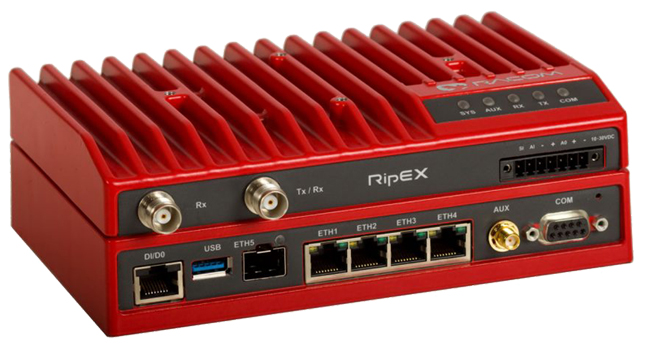
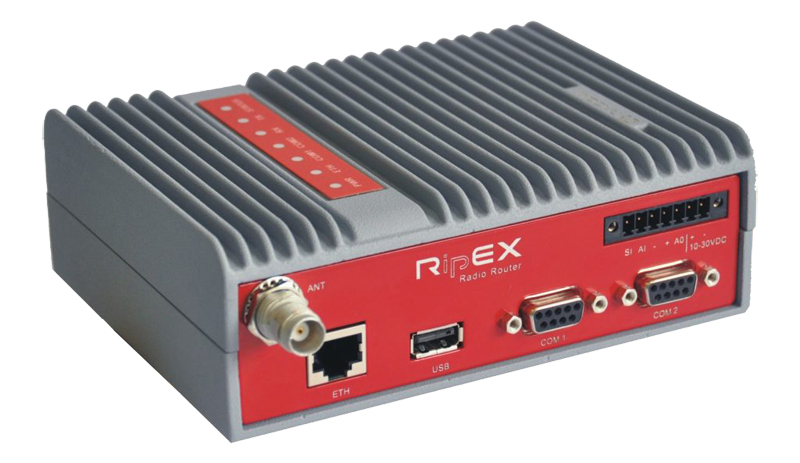
RipEX is a radio modem platform renowned for overall data throughput in any real-time environment. RipEX radio modems are native IP devices, Software Defined with Linux OS that have been designed with attention to detail, performance and quality. All relevant state-of-the-art concepts have been carefully implemented.
Specifications
RipEX
Key Features:
RipEX is a radio modem platform renowned for overall data throughput in any real-time environment. RipEX radio modems are native IP devices, Software Defined with Linux OS that have been designed with attention to detail, performance and quality. All relevant state-of-the-art concepts have been carefully implemented.
RipEX, 1st generation, is a best-in-class compact radio modem proven within the market since 2011 and used in thousands of installations.
• 166 kbps / 50 kHz / 16DEQAM
• 1× ETH, 2× COM, 1× USB
• Solar ready
• 0.1 – 10 watts
• – 40 to +70 °C
• WiFi management
• Customized protocols
• Backup routes
• Fast remote access IPsec

Radio parameters | |||||||||||||
Frequency bands | 135 – 154; 154 – 174 MHz | ||||||||||||
Channel spacing | 6.25; 12.5; 25; 50 kHz 1) | ||||||||||||
Frequency stability | ±1.0 ppm | ||||||||||||
Modulation | QAM (linear): 16DEQAM; D8PSK; π/4DQPSK; DPSK | ||||||||||||
FSK (exponential): 4CPFSK; 2CPFSK | |||||||||||||
FEC (Forward Error Correction) | On/Off, ¾ Trellis code with Viterbi soft-decoder | ||||||||||||
Gross data rate (data speed) 2) |
| ||||||||||||
Transmitter | |||||||||||||
RF Output power | QAM: 0.5 – 2 W 3) | ||||||||||||
Duty cycle | Continuous | ||||||||||||
Rx to Tx Time | < 1.5 ms | ||||||||||||
Intermodulation Attenuation | > 40 dB | ||||||||||||
Spurious Emissions (Conducted) | < -36 dBm | ||||||||||||
Radiated Spurious Emissions | < -36 dBm | ||||||||||||
Adjacent channel power | < -60 dBc | ||||||||||||
Transient adjacent channel power | < -60 dBc | ||||||||||||
Receiver | |||||||||||||
Sensitivity | -113 dBm (12.5 kHz, 2CPFSK, BER 10-6, 3/4 FEC | ||||||||||||
Anti-aliasing Selectivity | 50 kHz @ -3 dB BW | ||||||||||||
Tx to Rx Time | < 1.5 ms | ||||||||||||
Maximum Receiver Input Power | 20 dBm (100 mW) | ||||||||||||
Rx Spurious Emissions (Conducted) | < -57 dBm | ||||||||||||
Radiated Spurious Emissions | < -57 dBm | ||||||||||||
Blocking or desensitization | Blocking or desensitization values were determined according to the standards EN 302 561 V1.2.1 for 50 kHz channel, EN 300 113-1 V1.7.1 for 25 and 12.5 kHz channels, and ETSI 301 166-1 V1.3.2 for channel 6.25 kHz. | ||||||||||||
Spurious response rejection | > 70 dB | ||||||||||||
1) 50 kHz channel spacing is HW dependent, versions before 2014 didn´t support it. 6.25 kHz channel spacing is not available for RipEX-928. | |||||||||||||
2) Network throughput varies and depends heavily on the data structure, optimization effectivity, protocol on Radio channel, network topology, signal budgets and many other parameters of the network. Practical tests are recommended. | |||||||||||||
3) Max peak envelope power (PEP) 7.0 W | |||||||||||||
4) For output power 10 W it is recommended to use input power above 11 VDC. | |||||||||||||
RipEX-470, RipEX-928 – max. RF Output power 8 W. | |||||||||||||
Electrical | ||
Primary power | 10 to 30 VDC, negative GND | |
Rx | 5 W / 13.8 V; 4.8 W / 24 V; (Radio part < 2 W) | |
Tx | 13 – 40 W | |
Sleep mode | 0.1 W | |
Save mode | 2 W | |
Interfaces | ||
Ethernet | 10/100 Base-T Auto MDI/MDIX | RJ45 |
COM1 | RS232 | DB9F |
300 – 115 200 b/s | ||
COM2 | RS232/RS485 SW configurable | DB9F |
300 – 115 200 b/s | ||
USB | USB 1.1 | Host A |
Antenna | 50 Ω | TNC female |
Inputs/Outputs | 1x HW alarm input | Power connector |
Indication LEDs | |||
LED panel | 7× tri-color status LEDs | ||
Environmental | |||
IP Code (Ingress Protection) | IP40, (IP51 with special requirements) | ||
MTBF (Mean Time Between Failure) | > 900 000 hours (> 100 years) | ||
Hazardous lodations | Ex II 3G Ex ic IIC T4 Gc | ||
Operating temperature | −40 to +70 °C (−40 to +158 °F) | ||
Operating humidity | 5 to 95 % non-condensing | ||
Storage | −40 to +85 °C (−40 to +185 °F) / 5 to 95 % non-condensing | ||
Mechanical | |||
Casing | Rugged die-cast aluminium | ||
Dimensions | H × W × D: 50 × 150 × 118 mm (1.97 × 5.9 × 4.65 in) | ||
Weight | 1.1 kg (2.4 lbs) | ||
Mounting | DIN rail, L-bracket, Flat-bracket, 19″ Rack shelf | ||
SW | |||
Operating modes | Bridge / Router | ||
Radio channel protocols | Transparent @ Bridge | ||
User protocols on COM | Modbus, IEC101, DNP3, PR2000, UNI, Comli, DF1, RP570, Profibus, … | ||
User protocols on Ethernet | Modbus TCP, IEC104, DNP3 TCP, Comli TCP, | ||
Serial to IP convertors | Modbus RTU / Modbus TCP, DNP3 / DNP3 TCP | ||
Protocol on Radio channel | |||
Multi master applications | Yes | ||
Report by exception | Yes | ||
Collision Avoidance Capability | Yes | ||
Remote to Remote communication | Yes | ||
Addressed & acknowledged serial | Yes | ||
Data integrity control | CRC 32 | ||
Optimization | Payload data and Ethernet / IP / TCP / UDP header compression, Packet flow on Radio channel optimization | ||
Security | |||
Management | HTTP, HTTPS (own certificate), SSH | ||
Access accounts | 2 levels (Guest, Admin) | ||
Encryption | AES256-CCM | ||
VPN | IPsec, GRE | ||
VLAN | IEEE 802.1Q (tagging), Q-in-Q for Transparent mode | ||
Firewall | Layer 2 – MAC, Layer 3 – IP, Layer 4 – TCP/UDP | ||
Diagnostic and Management | |||
Radio link testing | Yes (ping with RSS, Data Quality, Homogeneity) | ||
Watched values (Can be broadcast to neighbouring units. Received info displayed in Neighbours table) | Device – Ucc, Temp, PWR, VSWR, *HW Alarm Input. | ||
Statistics | For Rx/Tx Packets on User interfaces (ETH, COM1, COM2) and for User data and Radio protocol (Repeats, Lost, ACK etc.) on Radio channel | ||
Graphs | For Watched values and Statistics | ||
History (Statistics, Neighbours, | 20 periods (configurable, e.g. days) | ||
SNMP | SNMPv1, SNMPv2c, SNMPv3 | ||
NTP | Client, Server (synchronized from internal GPS) | ||
Monitoring | Real time/Save to file analysis of all physical interfaces (RADIO, ETH, COM1, COM2) and some internal interfaces between software modules (e.g. Terminal servers, Modbus TCP server etc.) | ||
Standards | |
CE | RED, RoHS, WEEE |
FCC, IC | FCC Part 90, Pending: IC RSS-119 |
Spectrum | ETSI EN 302 561 V2.1.1:2017 |
EMC (electromagnetic compatibility) | ETSI EN 301 489-1 V2.1.1:2017 |
Safety | EN 60950-1:2006, A11:2009, A1:2010, A1:2010, A12:2011, A2:2013 |
SAR | EN 50385:2002 |
Vibration & shock | EN 61373:1999 |
Seismic qualification | IEC 980:1989 (seismic category 1a) |
Hazardous locations | EN 60079-0:2012 |
IP rating | EN 60529:1993 + A1:2001 + A2:2014 |
Downloads
- ripex-dsa4-en Download